What to Do When Someone Collapses: A Guide to Hands-Only CPR for Bystanders
You’re in a coffee shop when the person at the next table suddenly slumps forward. They’re unresponsive. Their chest isn’t moving. You have seconds to decide what to do.
This scenario plays out more than 350,000 times a year outside of hospitals in the United States. The vast majority of bystanders freeze, but it doesn’t have to be that way.
Hands-only CPR—CPR without mouth-to-mouth breathing—is something almost anyone can learn in minutes. And when performed in the first few minutes of cardiac arrest, it can double or even triple a person’s chance of survival.
This guide walks you through exactly what to do, why it works, and what the science says about bystander CPR.
First: Understand What’s Happening
Sudden cardiac arrest (SCA) is not the same as a heart attack, though a heart attack can trigger one. In cardiac arrest, the heart’s electrical system malfunctions and the heart stops pumping blood effectively. Without oxygenated blood reaching the brain, irreversible damage begins in as little as four to six minutes.
Every minute without CPR reduces survival odds by roughly 10%. By the time paramedics typically arrive—national average response time is eight to twelve minutes—the window for a good outcome is shrinking fast.
That gap is where bystanders matter most.
Why Hands-Only CPR Works
Traditional CPR combines chest compressions with rescue breaths. Hands-only CPR skips the breaths entirely. For adults who collapse from sudden cardiac arrest, the evidence shows this approach is just as effective in the critical first few minutes for a simple reason: the blood already circulating at the time of arrest still carries enough oxygen to keep the brain viable if compressions start immediately.
The American Heart Association updated its guidelines to support hands-only CPR for untrained bystanders precisely because removing the rescue breath step makes it less intimidating and more likely that someone will actually act.
When to Use Hands-Only CPR
Hands-only CPR is appropriate for:
- Adults and teenagers who suddenly collapse
- Anyone who is unresponsive and not breathing normally
- Situations where you are not trained in conventional CPR
It is NOT the recommended approach for:
- Drowning victims (rescue breaths are critical here)
- Children and infants (they need rescue breaths — call 911 and follow dispatcher instructions)
- Anyone who collapsed due to drug overdose or respiratory failure
When in doubt, start compressions and follow the 911 dispatcher’s instructions. Doing something is almost always better than doing nothing.
How to Perform Hands-Only CPR: Step by Step
- Check the scene. Make sure it’s safe to approach.
- Tap the person on the shoulder and shout. No response? They’re unresponsive.
- Call 911—or shout for someone specific nearby to call. Point at someone and say “You—call 911 now.” Vague calls for help often go unanswered.
- Ask someone to find an AED. These devices are increasingly common in public spaces—gyms, airports, malls, schools. If an AED is nearby, use it.
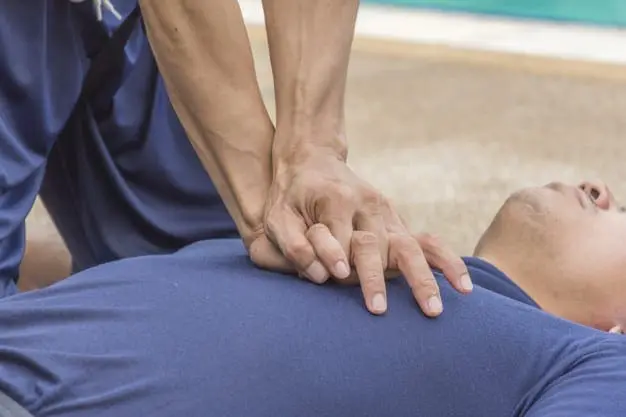
- Position your hands. Place the heel of one hand on the center of the person’s chest (on the lower half of the breastbone). Stack your other hand on top, interlace your fingers, and keep your fingers off the chest.
- Lock your elbows and position yourself directly above the person’s chest. You’ll use your body weight, not your arm strength.
- Push hard and fast. Compress the chest at least 2 inches deep at a rate of 100–120 compressions per minute. The beat of “Stayin’ Alive” by the Bee Gees is a well-known tempo guide.
- Don’t stop. Keep going until EMS arrives, an AED is ready to use, the person starts breathing normally, or you are physically unable to continue.
The Depth and Rate Matter More Than You Think
Ineffective compressions are a common problem even among trained responders. Research consistently shows that compressions are frequently too shallow or too slow in real emergencies.
The 2025 American Heart Association guidelines emphasize two numbers:
- Depth: at least 2 inches (5 cm) for adults
- Rate: 100–120 compressions per minute or roughly two per second
Pressing too lightly fails to generate adequate blood flow to the brain and heart.
Pressing at the right depth genuinely feels like effort and occasionally causes rib fractures. A cracked rib during CPR is a sign you’re doing it right, not a sign to stop. A broken rib is recoverable; cardiac arrest without compressions is not.
What Happens When the AED Arrives
Automated External Defibrillators (AEDs) are designed to be used by people with no medical training. They speak to you. They tell you where to place the pads, analyze the heart rhythm, and decide whether to deliver a shock. Your job is to follow the prompts and keep everyone clear when it says to stand back.
Do not stop compressions to wait for the AED. Compressions keep oxygenated blood moving to the brain. Resume compressions immediately after any shock is delivered.
Overcoming the Fear of Acting
Studies show that one of the biggest barriers to bystander CPR isn’t lack of knowledge—it’s fear of doing something wrong. People worry about hurting the person, about liability, about being judged if the outcome is bad.
Here’s the clinical reality: a person in cardiac arrest is already dying. Bystander CPR cannot make that situation worse. Across the United States, Good Samaritan laws protect bystanders who act in good faith in emergency situations.
The Case for Getting Trained
Hands-only CPR is a meaningful skill that requires no training to attempt in an emergency. But formal certification, particularly CPR/AED and First Aid courses, gives you a more complete skillset: confidence under pressure, practice on a manikin (which makes the compression depth more intuitive), and coverage of scenarios hands-only CPR doesn’t address, like pediatric emergencies, drowning, and choking.
It also gives you the muscle memory to act without hesitation. In a real emergency, hesitation costs time. Time costs lives.
Training doesn’t need to be a significant time investment. Many certification courses are a few hours and are available at locations across the country, including workplaces, schools, and community centers.
Click here to learn more about the benefits of CPR training for Community Leaders.
Key Takeaways
- Sudden cardiac arrest kills more than 350,000 Americans annually outside of hospitals.
- Bystander CPR in the first minutes can double or triple survival rates.
- For adults who collapse suddenly, hands-only CPR (no rescue breaths) is effective and recommended for untrained bystanders.
- Push hard (at least 2 inches), push fast (100–120 per minute), and don’t stop.
- Call 911 immediately and ask someone specific to find an AED.
- Good Samaritan laws protect bystanders who act in good faith.
Project Heartbeat has been an AHA Authorized Training Center since 1996.